
What is DQ?
We make thousands of decisions every single day.
These decisions that we face relate to…
- an almost infinite range issues
- with a high level of complexity
- in an uncertain and unpredictable world.
However, despite this, very few of us are trained in decision making, and many are not familiar with the decision tools and science that underpin the decision process.
As a result poor decision making is a very common and many decisions we make may be classed as sub-optimal decisions.
Why don’t we make better decisions?
A lot of research has focused on problems in decision-making, both within the discipline, but also in other areas such as behavioral economics and psychology.
Many issues have been identified, such as:
- Incorrect framing (we solve the wrong problem)
- Inherent biases (we can’t see the problem objectively)
- Poor or incorrect assumptions (we make mistakes)
- Irrational thinking (we are wrong)
… or maybe somebody was able to “sell” us their opinion or alternative, and we followed along rather than being critical thinkers.
But how do we address these and other problems so that we can actually make better decisions?
We need a framework or process
In order for us to make better decisions, we need a process that will help us go through the steps in decision-making in a considered and logical way.
If we follow a set process, we can ensure that we consider all alternatives, that we avoid biases, that we manage risk, that we understand uncertainty… and that we make better decisions.
Moreover, we need a process that will allow us to evaluate our decisions before and as we make them so that we can measure – not how “right” our decision turned out to be in the future – but how “good” our decision is at the time we make it.
Remember…
A good decision is not the same as a good outcome.
DQ means Decision Quality
Decision Quality is a concept and a framework that can help you to understand how “good” your decision is, and how “good” your decision process is, right now, real time.
The DQ framework is based on the six common elements of a “good” decision, and each decision can be evaluated on each of these steps throughout the decision-making process. By using DQ, you can address framing, de-biasing, analysis of alternatives, values and trade-offs, reasoning and rationality and even your commitment to action.
The DQ Process
To make a good decision, we need to follow a series of six steps as shown in the DQ chain.
Why is the process a chain?
The chain shows each of the six steps in order, starting with Appropriate Frame (what problem are we solving?) and ending with Commitment to Action (are we ready to decide and act on our decision?). But as the decision process unfolds, you may move forward and backward along the chain, advancing each of the links along the way.
However, the most important message is:
A decision is only as strong as its weakest link!
If you implement DQ correctly, following the links in the DQ chain, it will result in a deliberate, rational and transparent process, ensuring quality, good governance and sound processes.
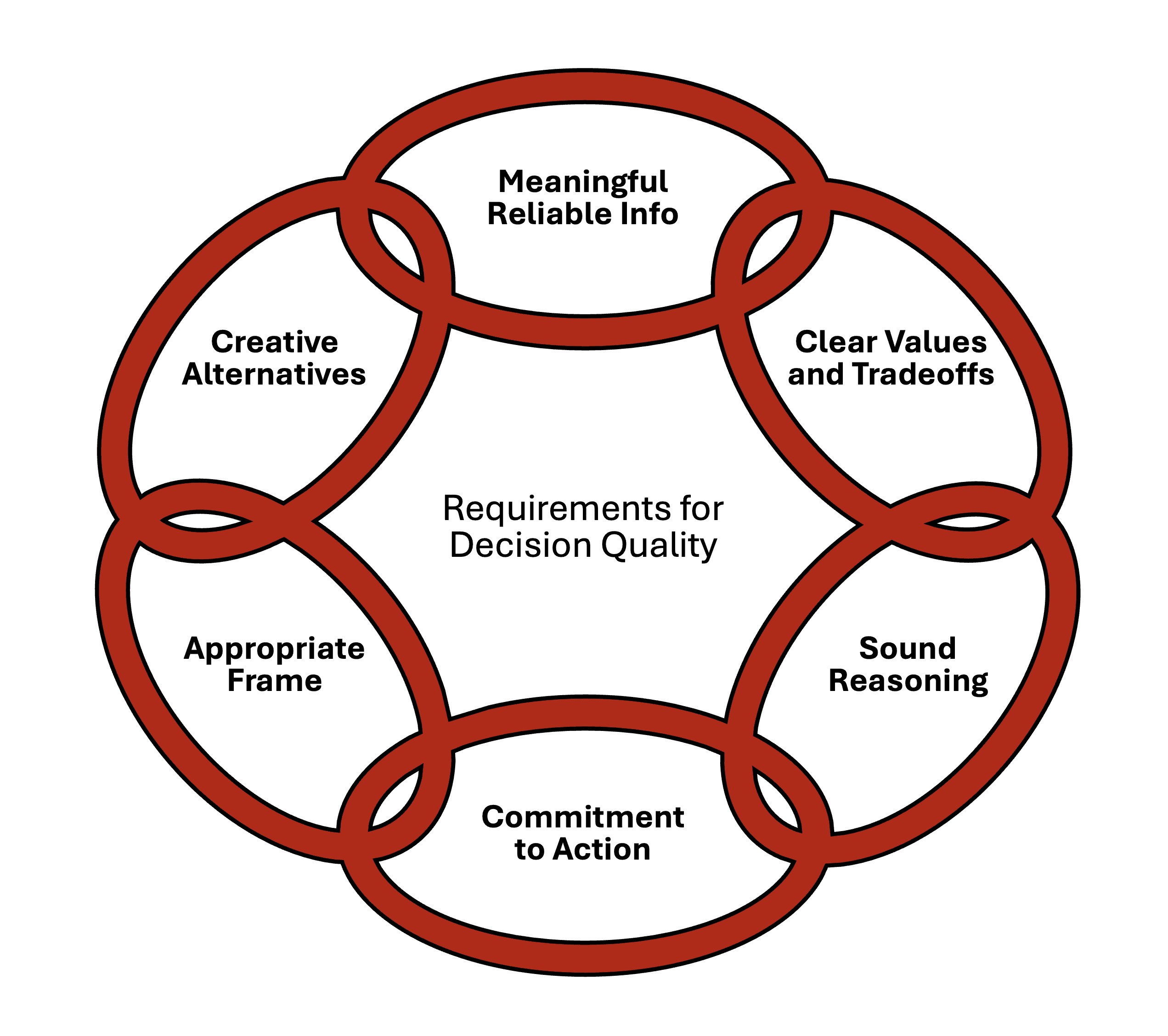
Going through the elements of the DQ Chain one by one…
1. Appropriate Frame – What problem are we solving?
We need to clearly understand the purpose and scope of the decision and our perspective.
What is it that we are deciding? And perhaps even more imporant, what is it that we are not deciding? What are we taking as given, and what can we decide later?
These questions help us to make sure that we are solving the “right” problem. The very best solution to the wrong problem is not a good solution at all!
2. Creative Alternatives – What could we do?
Once we know what problem we are solving, we can then move beyond the frame to consider what we could do.
Alternatives should be creative and different, but also reasonable, feasible and manageable. Multiple alternatives must exist to make a choice – if we have no alternatives, then we have no decision.
Watch out for “status quo” bias and options that are too limited. The idea is to create several clearly defined alternatives that can be evaluated.
3. Meaningful, Reliable Information – What do we know?
Decisions are about the future, and the future is uncertain. That’s why we rely on information — about facts, probabilities, forecasts, and assumptions — to make informed choices.
But not all information is equally useful. Some data is missing, some is unreliable, and some may even be misleading.
This step is about ensuring that the information we use is relevant, credible, and appropriate for the decision at hand.
4. Clear Values and Trade-offs – What matters most?
Every decision involves trade-offs. We usually want multiple things — to save money, reduce risk, be fast, be fair — but we can’t always get them all.
This step is about understanding what we care about and being clear on what we’re willing to give up to get something else.
5. Sound Reasoning – Are we thinking clearly?
This is where we bring it all together. We’ve framed the problem, generated options, gathered information, and clarified our values.
Now we need to weigh the alternatives logically, rigorously, and transparently.
This is the analysis step — where decision models, sensitivity testing, or just good structured thinking help us reason through the options.
6. Commitment to Action – Are we ready to decide and act?
Even the best decision process won’t help if we don’t follow through.
This final step is about turning a recommendation into real-world action — aligning stakeholders, getting buy-in, making the call, and doing what we’ve decided.
Decision Quality (DQ) is a framework that explicitly recognises these six elements. These elements can also be used as a checklist or a rating scale to ensure that all areas have been explored at the time a decision is made.
A Good Decision – Every Time!
We cannot know the future, and we cannot know how our decisions will turn out. However, having a sound decision process – and being ready to act on the results of that process – will give us our best hope for a good outcome.
By using the six elements of Decision Quality as a guide, we can dramatically improve how we make decisions, how we communicate about them, and how we learn from them.