
2026 SDP IN-PERSON WORKSHOPS
Experience learning that comes to life. SDP’s in-person workshops immerse you in interactive, hands-on sessions led by industry experts and thought leaders in Decision Quality.
Collaborate face-to-face with peers, engage in lively discussions, and practice applying new tools in real time. These sessions foster deep connection, creativity, and clarity—providing a powerful start (or finish) to your conference week.
Offered at an affordable rate, in-person workshops combine professional growth with meaningful networking, all in the energy and excitement of the live conference environment.

Why Attend a Workshop?
SDP workshops are your chance to dive deeper into the practice of Decision Quality with hands-on guidance from recognized industry experts.
These interactive sessions deliver practical tools, real-world insights, and fresh perspectives you can immediately apply in your work.
Whether you’re new to the field or a seasoned decision professional, workshops offer an engaging way to learn, connect, and grow—before, during, or after the conference.
Certification Credit for Workshops
Attending certain workshops at the 2026 SDP Annual Conference can count toward your SDP Certification requirements.
Associate Certification
Hours earned by attending framing-focused workshops contribute toward the required hours for Associate Certification.
A certificate of attendance will be provided upon request to document your participation and hours earned.
How to Identify Eligible Workshops
Look for the legend next to each workshop title to see how it applies:
⭐ Counts toward Associate Certification
Completing these workshops allows you to build practical Decision Quality skills while earning certification-eligible hours—an efficient way to deepen your expertise and advance your professional recognition.
Learn more about Associate Certification: View Associate Certification details
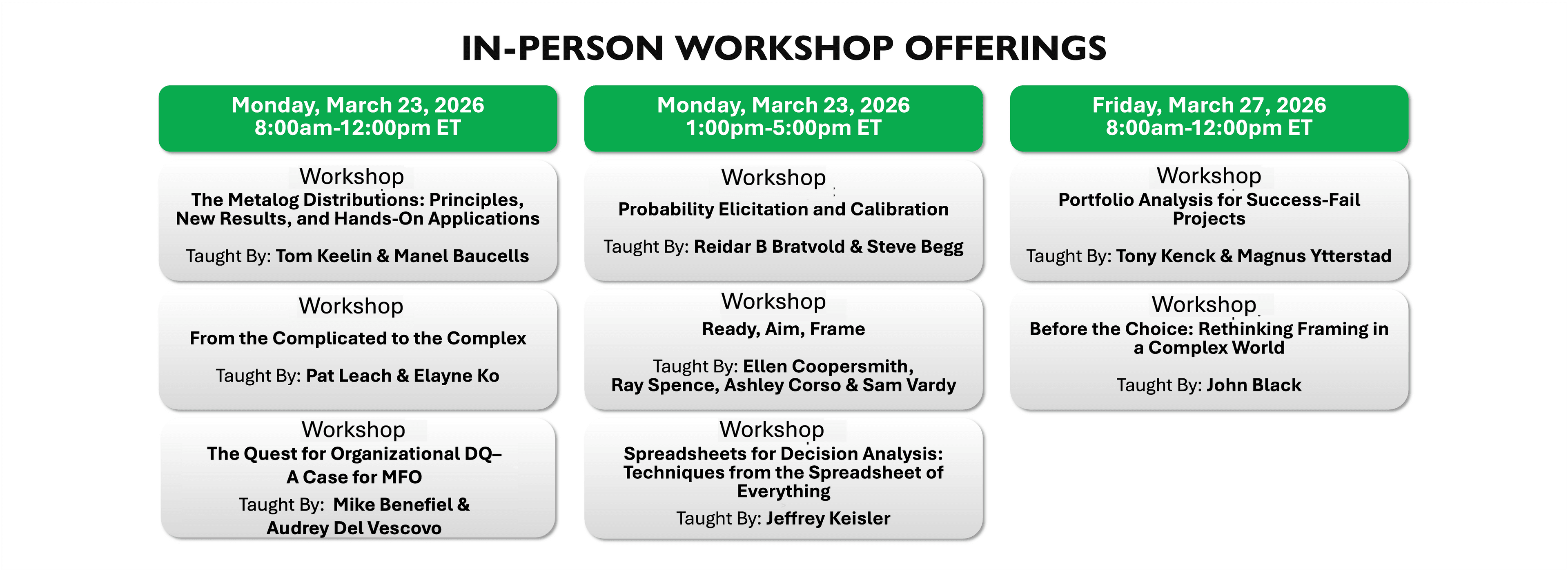
VIEW OUR IN-PERSON WORKSHOP AGENDA
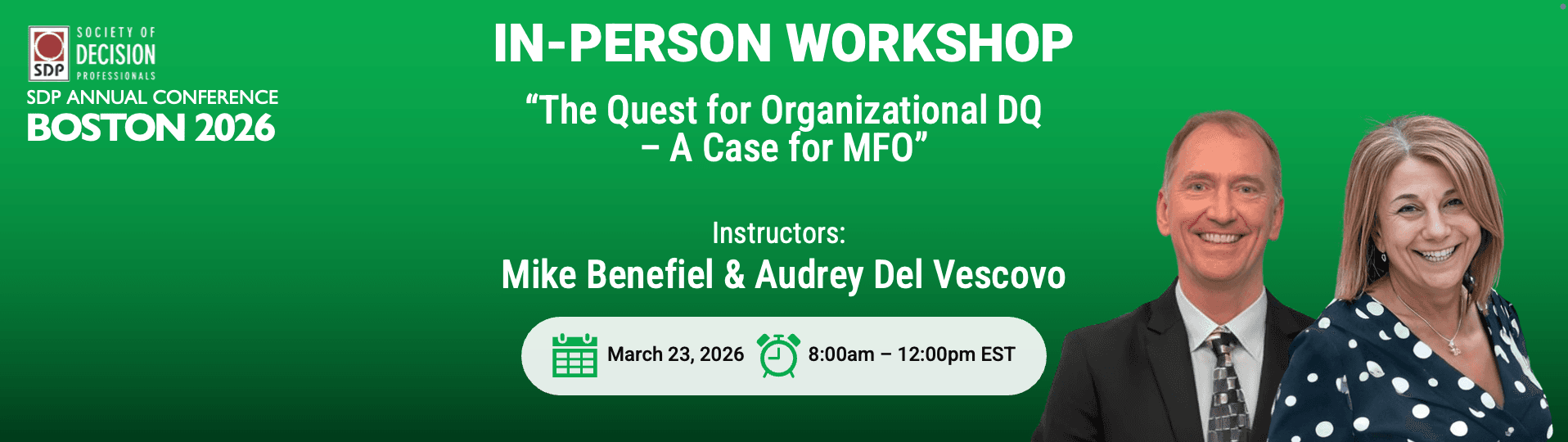
The Quest for Organizational Decision Quality – A Case for MFO
Abstract:
Achieving Organizational Decision Quality (ODQ) is a core ambition of many experienced decision professionals – yet it remains stubbornly elusive. Even with rigorous structured decision-making processes and expert decision support – all meant to ensure high decision quality – human behaviors can still silently undermine DQ.
This workshop is designed for experienced decision practitioners and DQ leaders who are committed to identifying opportunities to address DQ problems and strive towards ODQ.
Minimum Functional Objectives (MFO) can be an effective approach to support ODQ. MFO is a pragmatic, field-tested approach to DA that was built upon years of observation, hypothesis testing, and real-world application in a large, multinational organization. MFO builds on traditional DA foundations by emphasizing value clarity, incremental economics, cost discipline, and sound decision-making behaviors. This shift in decision-making ideology has helped teams and decision makers reduce unnecessary complexity, surface hidden objectives, improve alignment, and consistently achieve better DQ.
In this interactive workshop, instructors will share insights and experiences along their ODQ journey, the thinking behind MFO’s design & core principles, and why the approach has gained traction with senior leaders.
Participants will explore pitfalls in DA practices which can lead to DQ failure modes and will share & discuss experiences from their own ODQ journeys.
Participants will leave with:
•A clear understanding of how MFO differs from, and leverages, traditional DA
•An appreciation of how MFO’s approach instills behaviors that drive ODQ
•Actionable steps for strengthening ODQ drawn from participants’ experiences, insights, and learnings
Instructors: Mike Benefiel & Audrey Del Vescovo
Date: Monday, March 23, 2026
Time: 8:00am - 12:00pm
Type: In-Person Workshop
This Workshop is intended for:
- Experienced Decision Practitioners
- DQ Leaders
Meet our Workshop Instructors
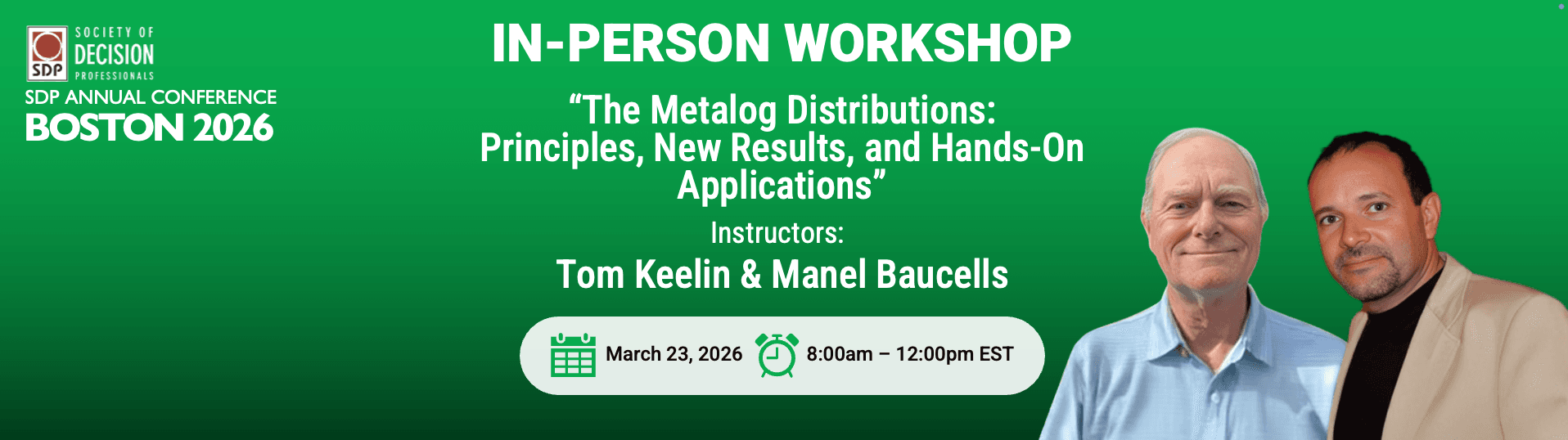
Workshop: The Metalog Distributions: Principles, New Results, and Hands-On Applications
Abstract:
Since their introduction in Decision Analysis (2016), the Metalog Distributions have rapidly gained adoption across diverse fields—from decision analysis and finance to astrophysics, earth sciences, and engineering—now with more than 100 published references. Originally designed for decision professionals, metalogs offer an unmatched combination of flexibility, tractability, and ease of use. They can closely approximate any continuous quantile function, handle unbounded, semi-bounded, and bounded cases, and are easy to assess from quantiles, fit to data, and simulate—often eliminating the need for other continuous distributions in practice.
This workshop will introduce and deepen understanding for beginner, intermediate, and expert users alike. Participants will learn how metalogs can:
- Represent virtually any continuous uncertainty without forcing inappropriate shape constraints.
- Fit expert assessments and empirical datasets with a simple linear algorithm—no nonlinear optimization required.
- Enable fast, exact simulation with algebraic inverse CDFs.
- Replace discrete approximations with smooth, accurate, continuous, distributions.
- Support advanced applications including combining expert assessments, multivariate modeling, Bayesian inference, and representing simulation outputs.
We will also present major advances from the newly released Metalog 2.0 paper, including:
- A mathematically exact feasibility test and a best-fit feasible metalog algorithm for any dataset.
- Unique term assignments that avoid degeneracy and improve estimation stability.
- Explicit expressions for all moments, partial expectations, and the number and location of modes.
Mathematics will be kept to the minimum needed for understanding, with emphasis on principles, practical results, and real-world examples. This hands-on, interactive session will include Excel workbooks and other tools so participants leave ready to apply metalogs immediately in their own work. Come prepared to see why, for many decision professionals, metalogs may be the only continuous distributions you will ever need.
Instructors: Tom Keelin & Manel Baucells
Date: Monday, March 23, 2026
Time: 8:00am - 12:00pm
Type: In-Person Workshop
This Workshop is intended for:
- New/Beginner Decision Practitioner
- Intermediate Decision Practitioner
- Experienced Decision Practitioner
Meet our Workshop Instructors
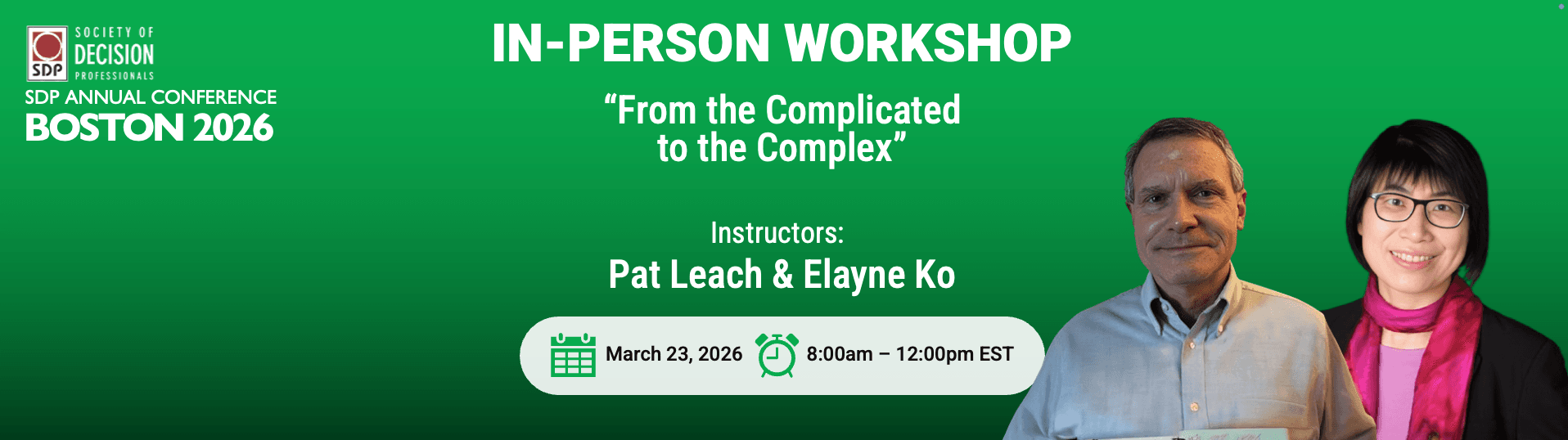
Workshop: From the Complicated to the Complex ⭐
Abstract:
Initially, decision analysis (DA) was used to analyze projects with large upfront development costs, long development timeframes, technical uncertainties, and uncertain revenue, such as pharmaceutical drug development and oil & gas projects. Over time, its application has expanded into many additional areas of business. Typically, the evaluation of and decision-making for these projects occur within a cross-functional team setting in the presence of conflicting objectives and multiple interpretations of the same datasets.
This workshop leverages the Cynefin framework developed by David Snowden and Mary Boone. This framework categorizes decisions into four primary arenas, depending on the degree of order in the system (Clear, Complicated, Complex, and Chaotic). Most strategic decisions fall into the Complicated and the Complex arenas, so those will be the focus of this workshop.
Traditional DA is tailored to Complicated situations, and that will be the focus of the first section of the workshop. We will review an established frame used to evaluate pharmaceutical late-stage drug development investment decisions, and by outlining some key considerations within the decision-making process that add intricacies to the decision frame which introduce nuances to the already Complicated decision. The section ends with a discussion on areas of improvement to the decision frame.
The second section addresses some of the major decisions we face as a global society, almost all of which are Complex (e.g., climate change). Finding solutions will require that we approach them differently from the way that we usually approach problems in DA. We will discuss several potential approaches that can provide insight in such situations.
The workshop closes with a discussion on human judgment that is needed in decision-making whether the decision arenas are Clear, Complicated, Complex or Chaotic. With the rise of AI, we will discuss potential ways to leverage AI to generate information and find creative solutions to both Complicated and Complex problems. The future is almost certainly going to be very different from the past along many dimensions (climate being an obvious one), but all AI tools have been trained on data from the past; to what extent do we expect the solutions that come from AI to be directly applicable? In addition, we would hope that ethics and equity would play key roles in developing plans to deal with societal problems, and AI may or may not weight those factors sufficiently.
Instructors: Pat Leach & Elayne Ko
Date: Monday, March 23, 2026
Time: 8:00am - 12:00pm
Type: In-Person Workshop
This Workshop is intended for:
- New/Beginner Decision Practitioner
- Intermediate Decision Practitioner
- Experienced Decision Practitioner
Meet our Workshop Instructors
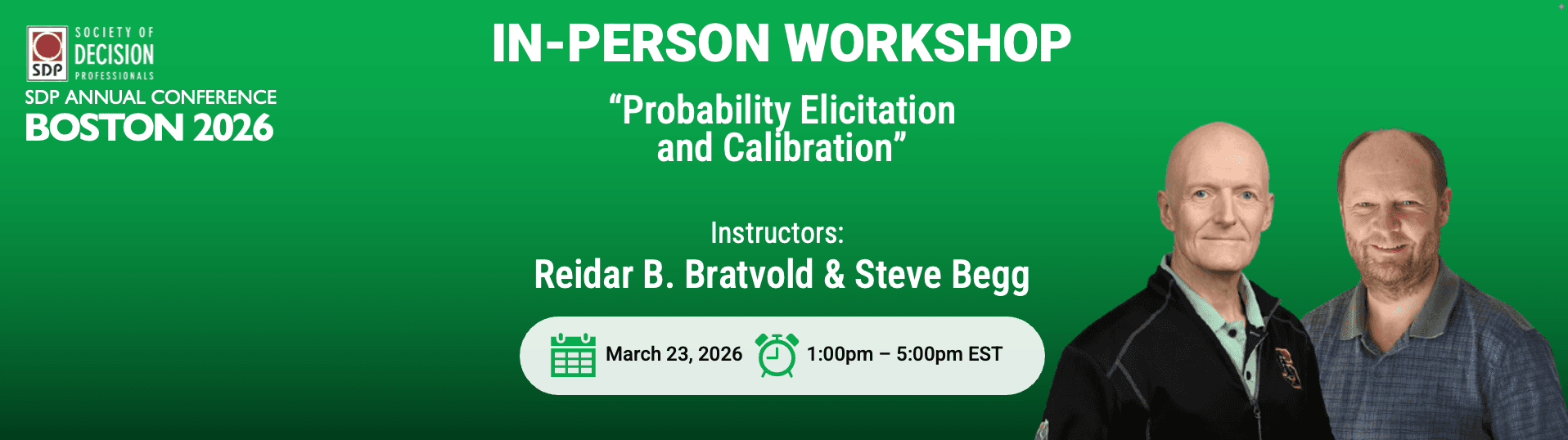
Workshop: Probability Elicitation and Calibration
Abstract:
Even in a world of intelligent systems and advanced analytics, human judgment remains critical - especially when decisions hinge on uncertain outcomes. Probability is how we quantify uncertainty, and probabilities are often assigned by subject matter experts (SMEs). However, most SMEs are not skilled in probability assignment and are prone to cognitive and motivational biases that degrade Decision Quality (DQ). Recent research shows that AI algorithms also exhibit biases. Elicitation is the structured process of helping SMEs assign probabilities. Calibration is how we evaluate the accuracy of those judgments.
This workshop focuses on how structured elicitation and calibration can improve decision quality by making uncertainty explicit and actionable. We will examine how uncertainty, risk, and variability affect decisions, and why expressing uncertainty probabilistically is essential for clear communication, shared understanding, and sound reasoning under uncertainty. The workshop emphasizes practical tools for assigning probabilities, evaluating judgment quality, and verifying performance through calibration and feedback.
Through real-world examples and interactive discussions, participants will learn how simple tools–such as percentile plots, Brier scores, and calibration diagnostics–can measure and visualize the accuracy of probability assignments. We also show how taking the outside view and Reference Class Forecasting are simple ways to reduce bias and overconfidence.
Participants will leave with practical tools and insights that can be implemented immediately to improve both individual and group judgments, and which are broadly applicable across industries and decision contexts.
Instructors: Reidar B. Bratvold & Steve Begg
Date: Monday, March 23, 2026
Time: 1:00pm - 5:00pm
Type: In-Person Workshop
This Workshop is intended for:
- New/Beginner Decision Practitioner
- Intermediate Decision Practitioner
- Experienced Decision Practitioner
Meet our Workshop Instructors

Workshop: Ready, Aim, Frame ⭐
Abstract:
This activity-based workshop will enable you to hone your decision framing skills. The workshop will be divided into three groups to develop a frame for a specific project opportunity. Each group will use AI to enrich their understanding of the opportunity and aid strategy creation. Attendees can select from the following three options:
Group 1 – Standard Decision Framing: Learn and practice the most common framing methods and tools, including defining the opportunity, soliciting and categorizing relevant issues, developing a decision hierarchy, building a strategy table, and defining and qualitatively assessing alternative strategies. This is ideal for those who are new to framing and Decision Quality.
Group 2 – De-Risking Decision Framing: A more advanced form of framing in which team members will frame alternative de-risking strategies (e.g., piloting, testing, and other forms of information gathering) to better understand critical uncertainties. Team members will use uncertainty tables to differentiate the uncertainties that could be de-risked, the future decisions that could be affected by the uncertain outcomes, and the information sources that comprise compelling, alternative de-risking strategies.
Group 3 – Scenario Thinking Decision Framing: Also a more advanced form of framing that assesses strategy robustness against future scenarios defined by the outcome of critical uncertainties. Team members will identify which uncertainties should be considered for scenario creation, develop interesting narratives for the scenarios, define compelling strategies that are likely to succeed in each scenario, and qualitatively assess each strategy’s viability and value in the different scenarios.
The workshop will conclude with each group sharing their product and learnings with the rest. Finally, we will compare each group’s results with what AI is able to produce.
Instructors: Ellen Coopersmith, Ray Spence, Ashley Corso & Sam Vardy
Date: Monday, March 23, 2026
Time: 1:00pm - 5:00pm
Type: In-Person Workshop
This Workshop is intended for:
- New/Beginner Decision Practitioner
- Intermediate Decision Practitioner
- Experienced Decision Practitioner
Meet our Workshop Instructors
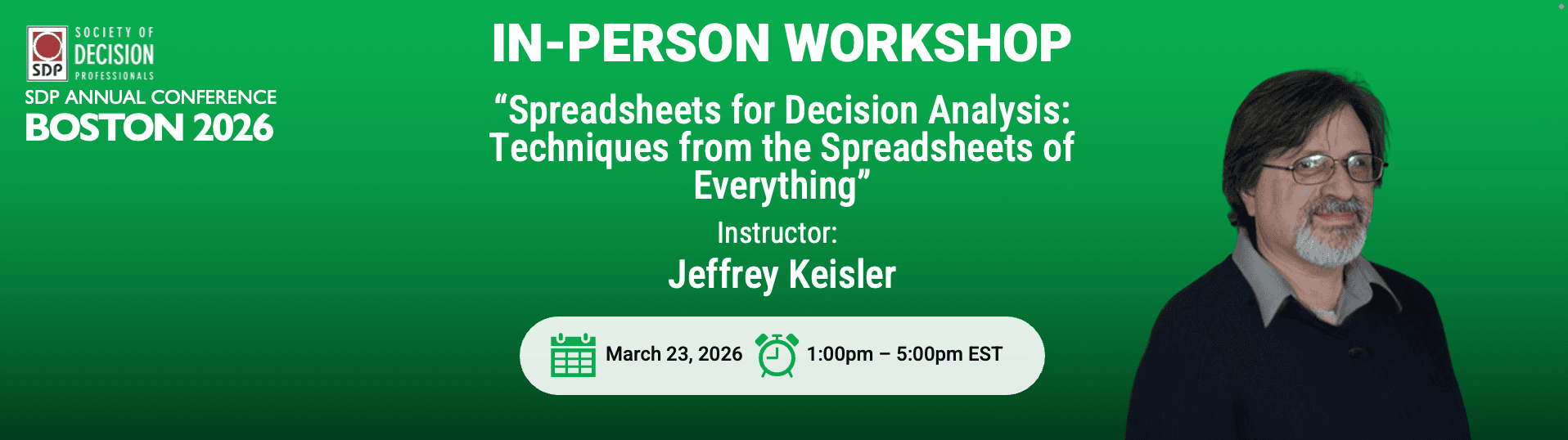
Workshop: Spreadsheets for Decision Analysis: Techniques from the Spreadsheet of Everything
Abstract:
This workshop introduces practitioners to spreadsheet-based decision analysis techniques developed in Prescriptive Analytics: Mastering the Spreadsheet of Everything.
Designed for decision professionals looking to expand their analytic toolkit and leverage existing experience, the session demonstrates how to use structured spreadsheet architectures to execute a wide range of decision analysis tasks in a convenient spreadsheet-only environment.
The workshop showcases a flexible modeling framework built on index-variable conventions, Excel data tables, and standard functions. Participants will work with modular templates that support a range of DA tasks, including sensitivity analysis, expected value and utility calculations, and value of information.
Additional and novel techniques arising from the architecture will be demonstrated as time permits.
These techniques are implemented in spreadsheet form for live, transparent calculation and visualization, enabling iterative learning and flexible client interfacing. Examples will use single-stage decision modeling, but with pointers to broader decision analytic applications and potential extensions.
The Spreadsheet of Everything architecture promotes modular thinking and a “building block” approach to modeling, supporting reuse, integration, and application across diverse decision contexts.
Instructor: Jeffrey Keisler
Date: Monday, March 23, 2026
Time: 1:00pm - 5:00pm
Type: In-Person Workshop
This Workshop is intended for:
- Decision professionals with working knowledge of spreadsheets and standard DA concepts. No specific prior tools are required.
Meet our Workshop Instructor
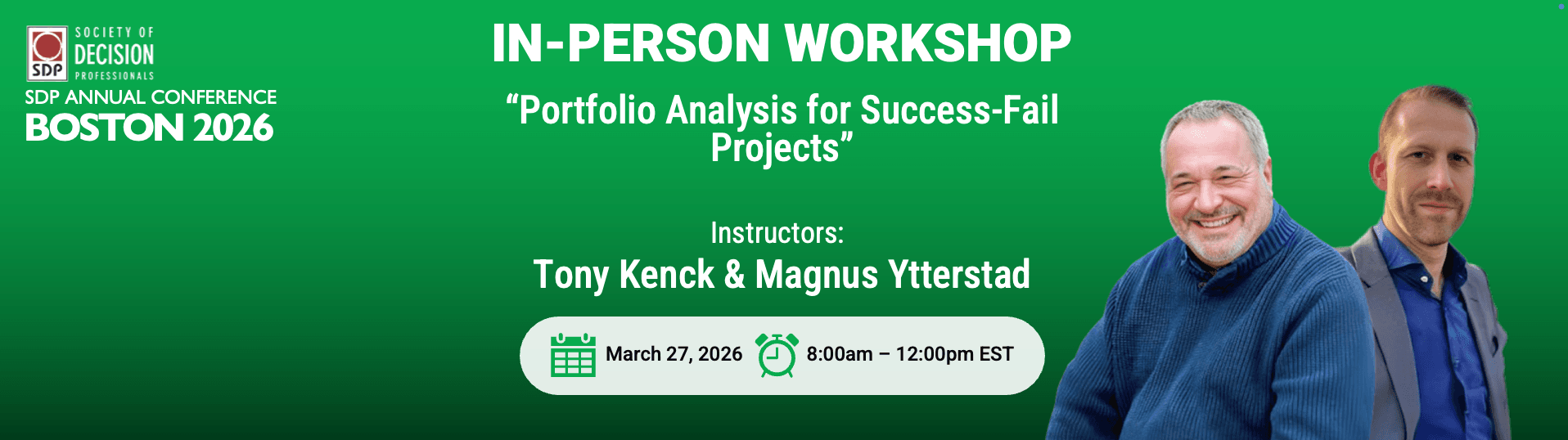
Workshop: Portfolio Analysis for Success-Fail Projects
Abstract:
Success-Fail investments, such as pharmaceutical research, oil exploration, and R&D in general, were some of the early uses of portfolio management outside of finance. These types of investments have a common pattern--you have an idea that may or may not work with a probability of success, you spend money to test the concept, and, if it works, you commercialize. They are typically dominated by the probability of success and also tend to have large uncertainty in the success case.
The general rules are to fail fast and cheap, and to fund only opportunities that have a chance to overcome the failure cost/probability of success gauntlet.
These opportunities are statistical in nature, so even though a single project may look like a good bet, many bites at the apple are needed to ensure success for the enterprise--a single, low-probability-of-success investment is seldom sufficient.
This workshop covers the requirements for inputs, the fundamental structure of these problems, and various methods for prioritizing and managing a portfolio of such opportunities.
Attendees will need a personal computer.
Instructors: Tony Kenck & Magnus Ytterstad
Date: Friday, March 27, 2026
Time: 8:00am - 12:00pm
Type: In-Person Workshop
This Workshop is intended for:
- New/Beginner Decision Practitioner
- Intermediate Decision Practitioner
- Experienced Decision Practitioner
Meet our Workshop Instructors
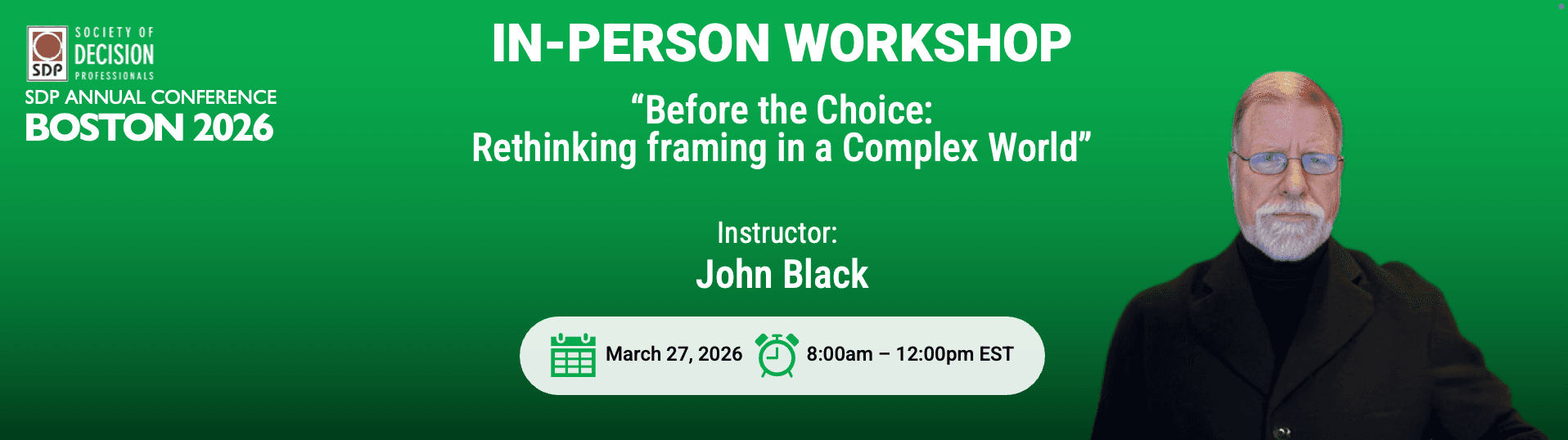
Workshop: Before the Choice: Rethinking Framing in a Complex World ⭐
Abstract:
What lives before that moment of choice, that commitment to action? We start with an appropriate frame, but where does this frame come from? Who decides the appropriateness? What is the quality and perspective of our framing? Most decision failures are not caused by poor data or faulty logic. They begin upstream, often below the surface in the unseen (and often unexamined) act of framing. This workshop introduces participants to a set of empirically grounded, cognitively simple moves (drawn from DSRP theory and related models) that help decision-makers identify, interrogate, and revise the way they define problems before modeling or deciding. Participants will learn how distinctions, relationships, perspectives, and system boundaries shape how they see problems and what they may miss in these upstream moments. Rather than discarding existing models such as the Six Links of Decision Quality, this workshop enhances them by showing how upstream framing directly affects each link’s validity and utility.
Designed for both novice and expert decision professionals, this workshop is interactive, practical, and gently provocative. Participants will experience “aha” moments as they uncover hidden assumptions and blind spots in their decision contexts. By the end, they will have a repeatable set of framing tools they can integrate into existing workflows and a rejuvenated respect for the cognitive architecture that underpins human sensemaking, our precursor to decision-making.
This is not a workshop about making decisions. It’s about learning how to see differently, so that the decisions you do make start from an understanding-centric scaffolding. Multiple perspectives and an examination of our internal metacognition are critical components in today’s environment of the human AI decision-making paradigm.
Instructor: John Black
Date: Friday, March 27, 2026
Time: 8:00am - 12:00pm
Type: In-Person Workshop
This Workshop is intended for:
- New/Beginner Decision Practitioner
- Intermediate Decision Practitioner
- Experienced Decision Practitioner
Meet our Workshop Instructor